




Scientific evidence confirms that a higher fibre intake lowers the risk of chronic disease and supports healthier ageing.
Although it is usually linked only to bowel regularity, dietary fibre is one of the nutrients with the greatest impact on health and longevity. Its effects go far beyond the digestive system: it shapes the gut microbiota, reduces chronic inflammation, improves metabolism and lowers the risk of cardiovascular disease, type 2 diabetes and some types of cancer.
By Adriana Martín Peral · Neolife Nutrition Unit · Published 16 November 2026
| What you’ll find in this article
• Why fibre does much more than keep you regular. • How much fibre we eat in Spain, and how much we should. • What role the gut microbiota plays in its benefits. • Whether you need a supplement, or simply a better diet. |
Why is fibre an underrated nutrient?
For decades, fibre was seen as a secondary nutrient whose main benefit was preventing constipation. However, research in recent years has radically changed that view.
We now know that fibre acts as a true regulator of metabolic and immune health, and it is one of the dietary components most closely linked to a lower risk of death from any cause.
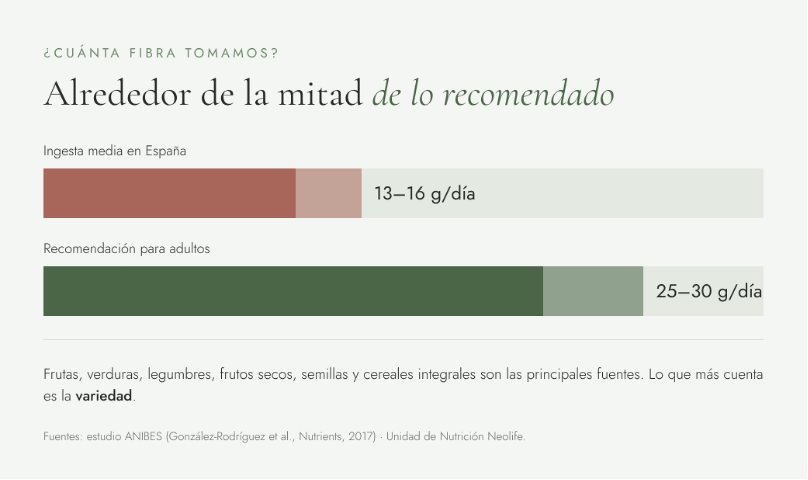
Paradoxically, most people eat far less than recommended. In Spain, according to the ANIBES study, average intake is around 13–16 g a day, well below the 25–30 g recommended for adults.
How does fibre work? The gut microbiota as the key mediator
Most fibre is not digested in the small intestine. Instead, it reaches the colon, where it feeds the gut bacteria.
This process produces short-chain fatty acids, especially butyrate, propionate and acetate, molecules of great physiological importance.
These metabolites:
- Maintain the integrity of the intestinal barrier.
- Reduce systemic inflammation.
- Improve insulin sensitivity.
- Help to regulate the immune system.
- May have a positive influence on brain health.
There is growing consensus that some of the benefits attributed to a healthy diet come precisely from this interaction between fibre and the gut microbiota.

What are the benefits of a high-fibre diet?
The benefits of a high-fibre diet are widely supported by epidemiological studies and meta-analyses.
A higher intake has been associated with:
- A lower risk of cardiovascular disease.
- A lower incidence of type 2 diabetes.
- A lower risk of colorectal cancer.
- Better body weight control.
- Lower LDL cholesterol.
- Better blood sugar control.
- Lower mortality from any cause.
These effects appear to depend on both the amount and the variety of the fibre sources eaten.
What types of fibre are there? Soluble and insoluble
Talking simply about “fibre” is an oversimplification. There are different types, with complementary roles:
Soluble fibre
- Found in oats, pulses, fruit and seeds.
- Forms viscous gels.
- Helps to control blood sugar and cholesterol.
- Is highly fermentable by the gut microbiota.
Insoluble fibre
- Mainly found in whole grains and many vegetables.
- Increases stool bulk.
- Supports intestinal transit.
What matters most is not prioritising one particular type, but eating a wide variety of plant foods.
Do you need a fibre supplement?
Although some fibre supplements have specific uses, most of the benefits seen in studies come from regularly eating fibre-rich foods.
Fruit, vegetables, pulses, nuts, seeds and whole grains provide not only fibre but also vitamins, minerals, polyphenols and other bioactive compounds that work together.
So increasing your fibre intake is not just a matter of adding a supplement, but of improving the overall quality of your diet.
Conclusions
In nutrition, few nutrients have such solid scientific backing as dietary fibre. Its ability to shape the gut microbiota, reduce inflammation and help prevent many diseases makes it a true ally of healthy ageing.
At a time when precision medicine is focusing on prevention, eating more fibre-rich foods is one of the simplest, safest and most effective ways to support long-term health.
Key ideas
- In Spain, average fibre intake is around 13–16 g a day, about half of the 25–30 g recommended (ANIBES study).
- Fibre feeds the gut microbiota, which produces short-chain fatty acids (butyrate, propionate and acetate) that act on inflammation, insulin and the immune system.
- A higher intake is associated with less cardiovascular disease, type 2 diabetes, colorectal cancer and death from any cause.
- What matters most is a wide variety of plant foods, rather than one particular type of fibre or a supplement.
Frequently asked questions about fibre
How much fibre should you eat per day?
Between 25 and 30 g a day for adults. In Spain, average intake is around 13–16 g a day, well below that recommendation.
Which foods are highest in fibre?
Fruit, vegetables, pulses, nuts, seeds and whole grains. As well as fibre, they provide vitamins, minerals, polyphenols and other bioactive compounds that work together.
What is the difference between soluble and insoluble fibre?
Soluble fibre (oats, pulses, fruit, seeds) forms viscous gels, helps to control blood sugar and cholesterol, and is highly fermentable by the gut microbiota. Insoluble fibre (whole grains and many vegetables) increases stool bulk and supports intestinal transit.
Why is fibre good for the gut microbiota?
Most fibre reaches the colon undigested and feeds the gut bacteria, which produce short-chain fatty acids (butyrate, propionate and acetate). These help to maintain the intestinal barrier, reduce systemic inflammation and improve insulin sensitivity.
Is it better to take a fibre supplement?
Generally not. Some fibre supplements have specific uses, but most of the benefits seen in studies come from regularly eating fibre-rich foods.
References
- Reynolds A, Mann J, Cummings J, Winter N, Mete E, Te Morenga L. Carbohydrate quality and human health: a series of systematic reviews and meta-analyses. The Lancet. 2019;393(10170):434-445. doi: 10.1016/S0140-6736(18)31809-9.
- McRae MP. Dietary Fiber Intake and Type 2 Diabetes Mellitus: An Umbrella Review of Meta-analyses. Journal of Chiropractic Medicine. 2018;17(1):44-53. doi: 10.1016/j.jcm.2017.11.002.
- Barber TM, Kabisch S, Pfeiffer AFH, Weickert MO. The Health Benefits of Dietary Fibre. Nutrients. 2020;12(10):3209. doi: 10.3390/nu12103209.
- Fan Y, Pedersen O. Gut microbiota in human metabolic health and disease. Nature Reviews Microbiology. 2021;19(1):55-71. doi: 10.1038/s41579-020-0433-9.
- Makki K, Deehan EC, Walter J, Bäckhed F. The Impact of Dietary Fiber on Gut Microbiota in Host Health and Disease. Cell Host & Microbe. 2018;23(6):705-715. doi: 10.1016/j.chom.2018.05.012.
- González-Rodríguez LG, Perea Sánchez JM, Aranceta-Bartrina J, Gil Á, González-Gross M, Serra-Majem L, Varela-Moreiras G, Ortega RM. Intake and Dietary Food Sources of Fibre in Spain: Differences with Regard to the Prevalence of Excess Body Weight and Abdominal Obesity in Adults of the ANIBES Study. Nutrients. 2017;9(4):326. doi: 10.3390/nu9040326.