





For years, weight loss has mainly been approached from a simple perspective: eat less and move more. However, current evidence shows that this approach is insufficient to explain what happens in clinical practice.
Most diets do not fail because of a lack of knowledge, but because they fail to take into account how the body responds and how eating behavior is regulated over time.
Meritxell Massons – Neolife Nutrition Unit
What Happens in the Body When We Diet?
When calorie intake is reduced, the body activates adaptive mechanisms whose purpose is not aesthetic, but survival.
One of the main factors explaining why long-term diets fail is metabolic adaptation.
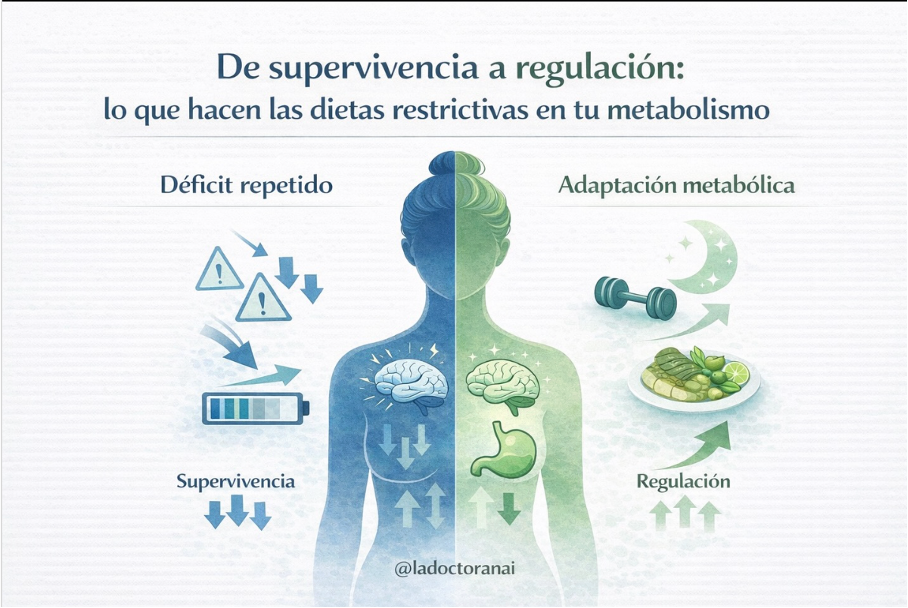
Metabolic adaptation
One of the main reasons why long-term diets do not work is metabolic adaptation, which occurs when a calorie deficit is maintained:
- Resting energy expenditure decreases.
- Activity-related energy expenditure is reduced.
- The body becomes more energy efficient.
Appetite Regulation: Hormonal Changes
Weight loss induces changes in key hormones:
- Decreased leptin levels (satiety signal).
- Increased ghrelin levels (hunger stimulation).
The result is a greater tendency to eat, even in individuals with high initial adherence.
Loss of Muscle Mass
Poorly structured or overly restrictive diets can lead to muscle mass loss, which results in:
- Reduced basal metabolic rate.
- Decreased ability to oxidize energy.
- Regain of body fat.
Behavior: The Key Factor
Beyond physiology, the success of a nutritional plan depends on whether it is sustainable. Evidence shows that weight loss does not depend solely on calorie deficit, but on the ability to maintain it over time.
This is where behavior becomes essential, as strict diets:
- Are difficult to maintain.
- Increase cravings for restricted foods.
- Promote episodes of loss of control.
In addition, external factors such as stress, lack of time, or food availability contribute additional strain on the body.
The Restriction–Loss of Control Cycle
A common pattern seen in clinical practice is:
Restriction → increased cravings → loss of control → guilt
This cycle makes adherence more difficult and promotes treatment abandonment.
The Solution in Clinical Practice
In clinical practice, this translates into:
- Avoiding aggressive calorie deficits.
- Prioritizing the preservation of muscle mass.
- Ensuring adequate protein intake.
- Evaluating long-term sustainability.
- Promoting healthy lifestyle habits.
The goal is not only to induce weight loss, but to create a metabolic and behavioral context that allows it to be maintained.

Conclusion
Most diets fail not because of a lack of discipline, but because they fail to consider the body’s physiological response and eating behavior.
The body adapts by reducing energy expenditure and increasing appetite, while restrictive strategies make adherence more difficult.
Therefore, long-term success does not depend on extreme measures, but on designing interventions that respect physiology, adapt to the individual, and can be maintained over time.
Ultimately, losing weight is not just a matter of calories, but of strategy, context, and sustainability.
BIBLIOGRAPHY
(1) Thom, G., et al. (2021). Weight loss-induced increase in fasting ghrelin concentration is a predictor of weight regain. Diabetes, Obesity and Metabolism.
(2) Nunes, C. L., et al. (2021). Adaptive thermogenesis after weight loss: a systematic review.
(3) López-Torres, S. Y., et al. (2024). Adaptive thermogenesis at the level of resting energy expenditure after diet-induced weight loss. Obesity (Silver Spring).
(4) Hall, K. D., & Kahan, S. (2023). Maintenance of lost weight and long-term management of obesity. Medical Clinics of North America.