




In recent years, we have started to look at health from a different perspective. For a long time, the goal was clear: prevent disease and extend lifespan. However, this approach falls short when we try to understand what actually happens in the body over time.
The reality is more nuanced. A person may have no diagnosis and yet have already begun to lose part of their physical, metabolic, or cognitive capacity. This is not a sudden or obvious change, but a gradual process that often goes unnoticed for years.
Dr. Carlos Martí – Neolife Medical Team
It’s Not Just About Being Healthy, but Understanding How Your Body Functions
When we think about health, we usually reduce it to the absence of disease. However, this perspective does not reflect how the body truly evolves over time.
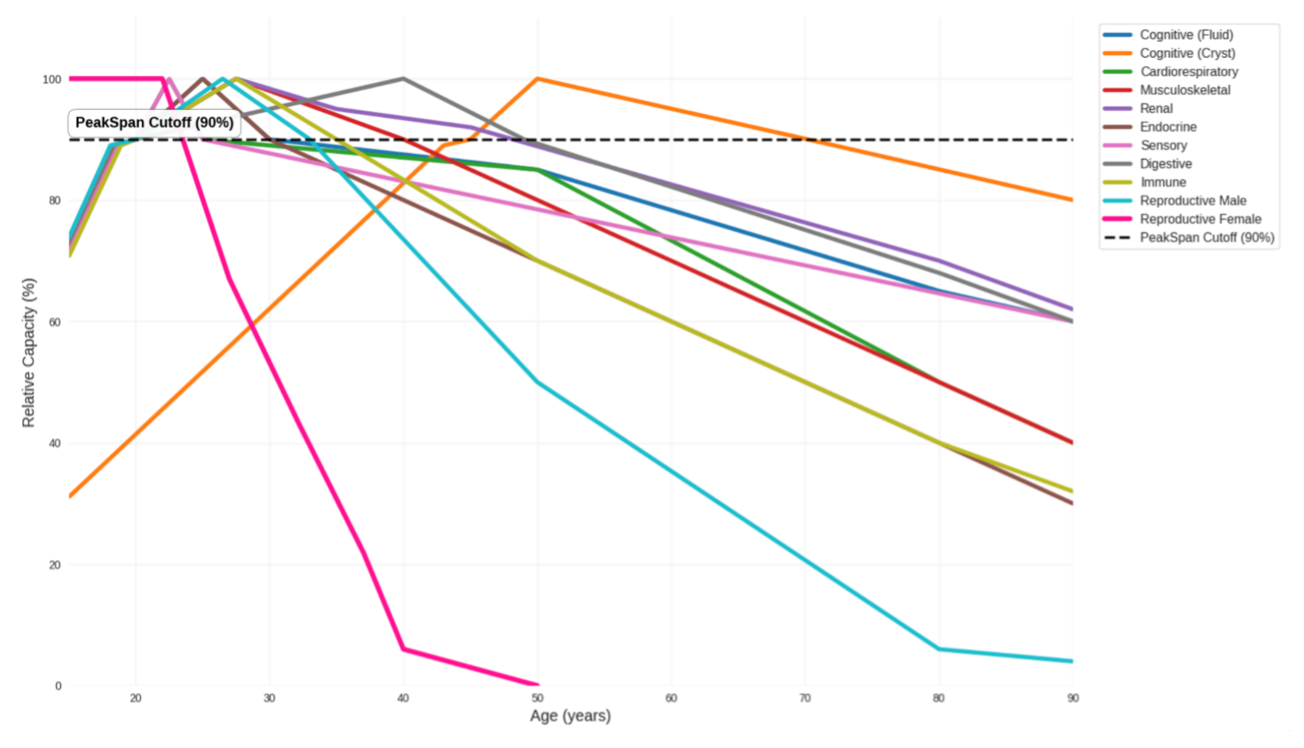
Each system in the body has a point of peak performance, typically reached in relatively early adulthood. From that point onward, a gradual decline begins—one that is not always immediately noticeable. This is not an abrupt change, but a progressive reduction in function that affects multiple levels: physical capacity, metabolic function, cognitive performance, and immune response.
In this context, the concept of Peakspan has been introduced. It refers to the period during which the body remains close to its maximum functional potential, typically within a range near that peak. It is not about how long we remain disease-free, but how long we can maintain a high level of functioning.
What is particularly relevant is that this period is much shorter than we intuitively assume. Although life expectancy has increased significantly, most physiological functions begin to move away from their optimal point decades before any disease or clear clinical limitations appear.

The Silent Decline: When the Change Really Begins
One of the most important insights is that loss of capacity does not coincide with the onset of disease. Between these two points, there is a long period during which the body is still clinically “healthy” but already functioning below its optimal level.
This decline begins earlier than we tend to think. Many functions reach their peak in the third decade of life and then gradually decline. Initially, this is not clearly perceived, but it manifests through subtle changes: reduced endurance, slower recovery after exertion, decreased adaptability to stress, or more frequent infections.
This leads to what can be described as a state of being “healthy but with reduced performance,” where no diagnosable pathology is present, yet there is a growing gap from maximum functional potential.
As a result, two individuals with similar lab results may be at very different stages of this process. One may still be functioning close to their peak, while the other has already moved significantly away from it—even though both are considered clinically healthy.
Understanding this decline as part of the process allows for earlier intervention. The goal is not to wait for abnormalities to appear, but to identify when capacity begins to decrease and how it evolves in each individual.
When the Body Really Starts to Change
When different physiological functions are analyzed separately, as described in recent research on Peakspan, a clear pattern emerges: there is no single starting point for aging, but multiple trajectories that begin earlier than we typically perceive.
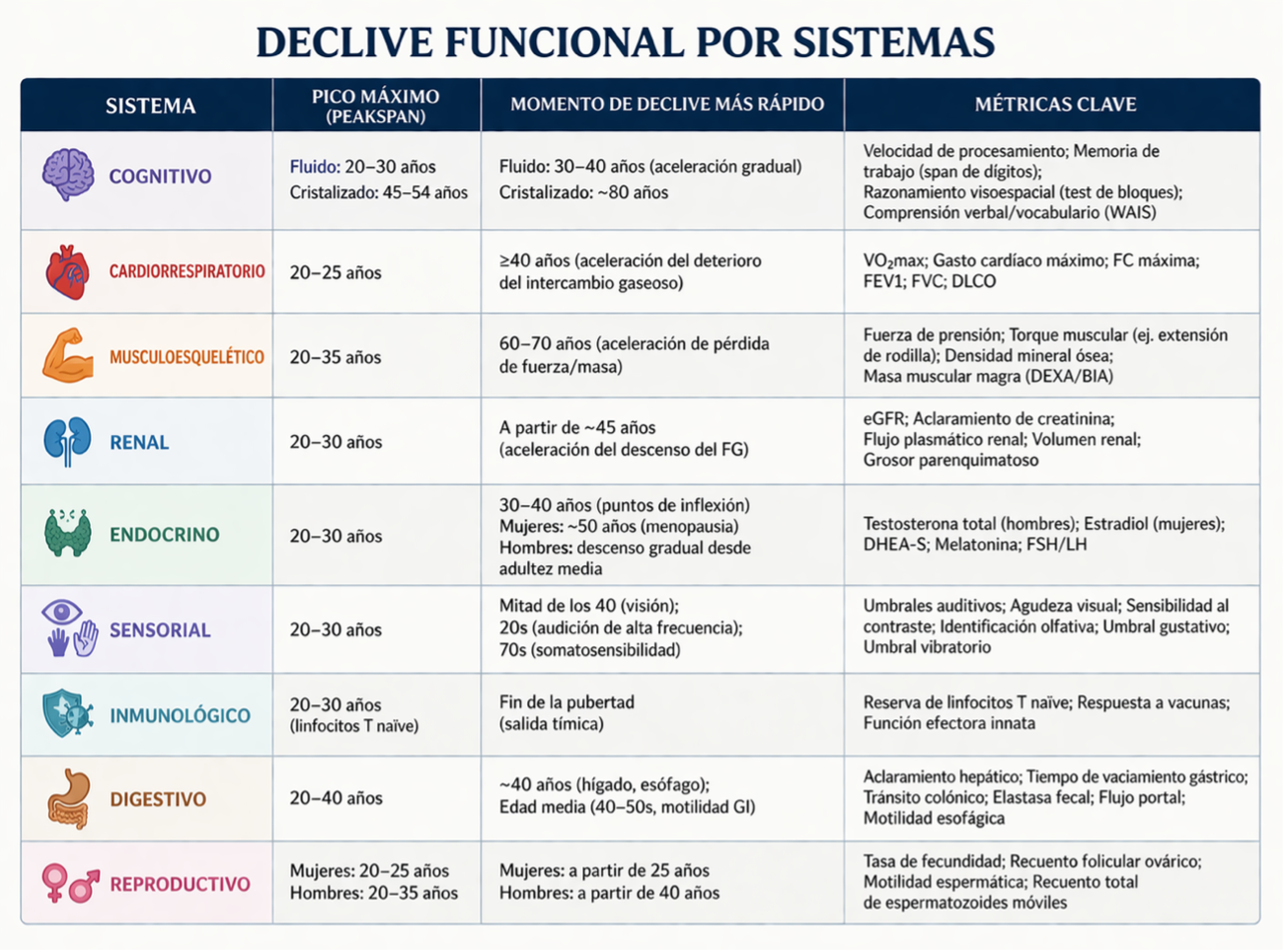
In the cognitive domain, abilities related to processing speed and working memory peak between the ages of 20 and 30, and then begin to decline, while other skills linked to experience are maintained for longer.
At the cardiorespiratory level, aerobic capacity and lung function reach their peak in the second or third decade, followed by a gradual decline. Similarly, muscle strength and mass peak between the ages of 20 and 35, with a period of stability before a more noticeable decline begins.
Other systems also show early changes. Kidney function begins to decline as early as the third decade, the endocrine system experiences gradual hormonal decreases from mid-adulthood, and the immune system shows reduced responsiveness from early adulthood.
Sensory and digestive systems follow a similar pattern, with changes appearing earlier than expected, such as high-frequency hearing loss or alterations in gastrointestinal motility and liver function from midlife onwards.
Overall, functional aging is an early and non-uniform process, in which different systems move away from their optimal state long before diseases or evident limitations appear.
Maintaining Capacity for as Long as Possible
This shift in perspective requires redefining what we mean by prevention. It is not only about avoiding disease, but about intervening in the functional trajectory before the decline becomes established.
The value of the Peakspan concept lies not only in describing the problem, but in identifying the point where there is the greatest opportunity for intervention: when function begins to move away from its near-optimal range. Acting at this stage allows us to modify the rate of decline and extend the period during which different systems maintain high performance.
This approach requires a more precise assessment, focused not only on isolated parameters but on the integration of functional, metabolic, and structural data to understand where each patient stands. The combination of biomarkers, functional testing, and lifestyle assessment provides a more complete view of this trajectory.
At Neolife, this model is part of daily clinical practice. Evaluation is aimed at early identification of which systems have begun to lose efficiency, followed by targeted interventions on the underlying mechanisms. This includes addressing cardiorespiratory capacity, muscle mass, metabolic balance, hormonal function, and sleep quality—all key determinants of functional capacity over time.
The goal is not only to delay the onset of disease, but to sustain the highest possible level of functioning for longer. This is the true paradigm shift in longevity medicine.
BIBLIOGRAPHY
(1) Zhavoronkov A, Ying K, Wilczok D. Peakspan: Defining, Quantifying and Extending the Boundaries of Peak Productive Lifespan. Aging Dis. 2026 Feb 25. doi: 10.14336/AD.2026.0080. Epub ahead of print. PMID: 41747171.
(2) López-Otín C, Blasco MA, Partridge L, Serrano M, Kroemer G. Hallmarks of aging: An expanding universe. Cell. 2023 Jan 19;186(2):243-278. doi: 10.1016/j.cell.2022.11.001. Epub 2023 Jan 3. PMID: 36599349.